

Date Code Vision System
A deep learning vision system built to classify date codes on packaging in a live food manufacturing environment, using a convolutional neural network running on a Raspberry Pi. Developed as an MSc project at Ulster University and designed to solve a real quality control problem that had cost the business tens of thousands of pounds.
- Category
- AI & Computer Vision
- Status
- completed
- Location
- Northern Ireland
Project Overview
In food manufacturing, incorrect date codes printed on packaging due to operator entry errors are a serious quality issue. Each incident can result in product recalls, retailer fines, and significant financial loss, in some cases tens of thousands of pounds per occurrence. Thomas Hadden chose this as the engineering problem for his MSc Internet of Things project at Ulster University, opting to solve a genuine workplace issue rather than an academic exercise.
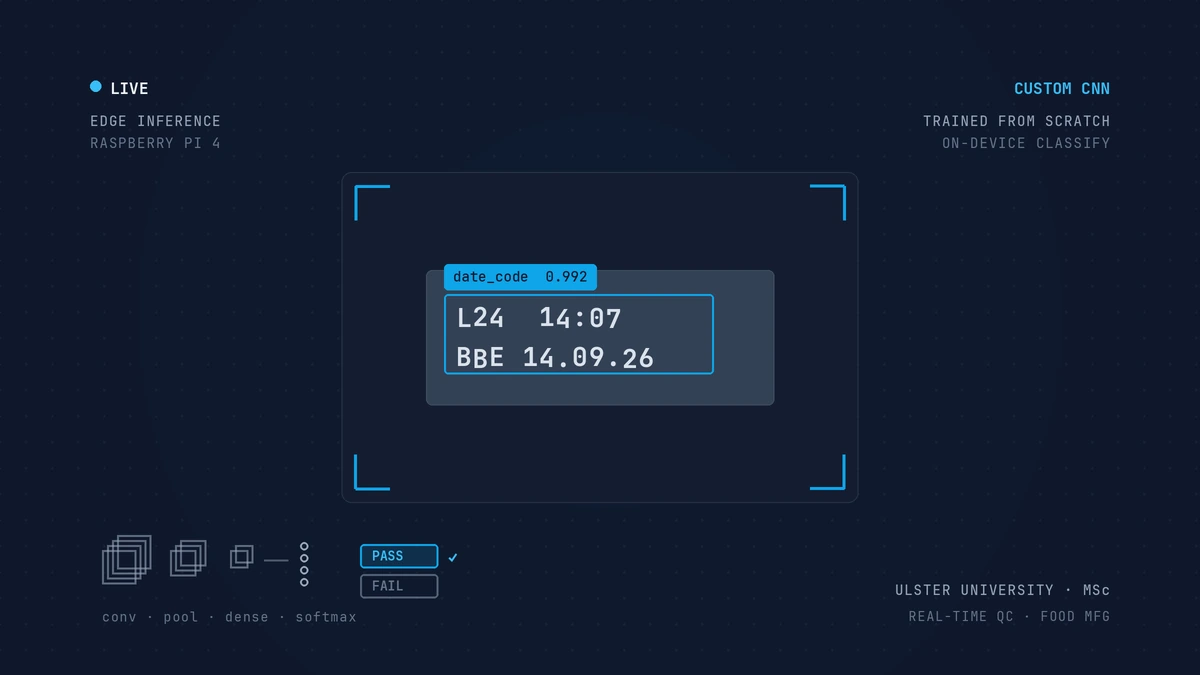
The solution used deep learning to classify dot-matrix printed date codes on packaging as it moved along a conveyor line. Thomas designed the system to capture images, perform preprocessing, and run inference against a trained model, raising an alarm to the operator if the date fell outside the expected range.
Thomas built the training dataset by collecting and labelling images of printed date codes from the production line, then developed and trained a custom convolutional neural network (CNN) in Python using TensorFlow. The model was trained on a desktop machine and deployed to a single board computer for edge inference.
The project encountered real-world engineering challenges. TensorFlow required a 64-bit operating system, but the specified camera module only supported 32-bit. Thomas adapted by using a USB webcam, though this introduced image clarity challenges, particularly with product in motion on the conveyor. These compromises and their impact on classification accuracy were documented and evaluated as part of the project.
The project received a mark of 85% and generated interest from the manufacturing business in developing the system into a full industrial solution. Thomas published the code to GitHub and identified Docker containerisation as an improvement for future deployability, a technique he subsequently adopted in later projects.
The project demonstrated that applied AI can address genuine manufacturing quality problems using low-cost hardware, and that the gap between academic prototypes and production-ready systems is primarily an engineering challenge rather than a theoretical one.
Technologies
- Python
- TensorFlow
- Convolutional neural networks (CNN)
- Raspberry Pi
- Computer vision
- Image preprocessing
- Edge inference
- Docker (identified for future iteration)