

Bearing Fault Detection Using Wavelet Methods and Machine Learning
Research into detecting roller element bearing faults using wavelet decomposition and unsupervised machine learning, eliminating the need for application-specific equipment configuration. Co-authored with Dr Muhammad Usman Hadi at Ulster University and submitted to Elsevier.
- Theme
- Applied AI
- Status
- completed
Research Overview
Detecting faults in roller element bearings is critical to maintaining machinery uptime in industrial environments. The established methods, time domain metrics like RMS and crest factor, frequency spectrum analysis, envelope detection, all work, but they share a common limitation: each monitoring system has to be specifically configured for the bearing type, fault frequencies, and operating conditions of every application. This setup process requires significant domain knowledge and is a real barrier to adoption, particularly for smaller operations or facilities with diverse equipment.
Thomas Hadden's research, conducted during his MSc Internet of Things at Ulster University and co-authored with Dr Muhammad Usman Hadi, investigated whether wavelet methods combined with unsupervised machine learning could detect bearing faults without any application-specific configuration.
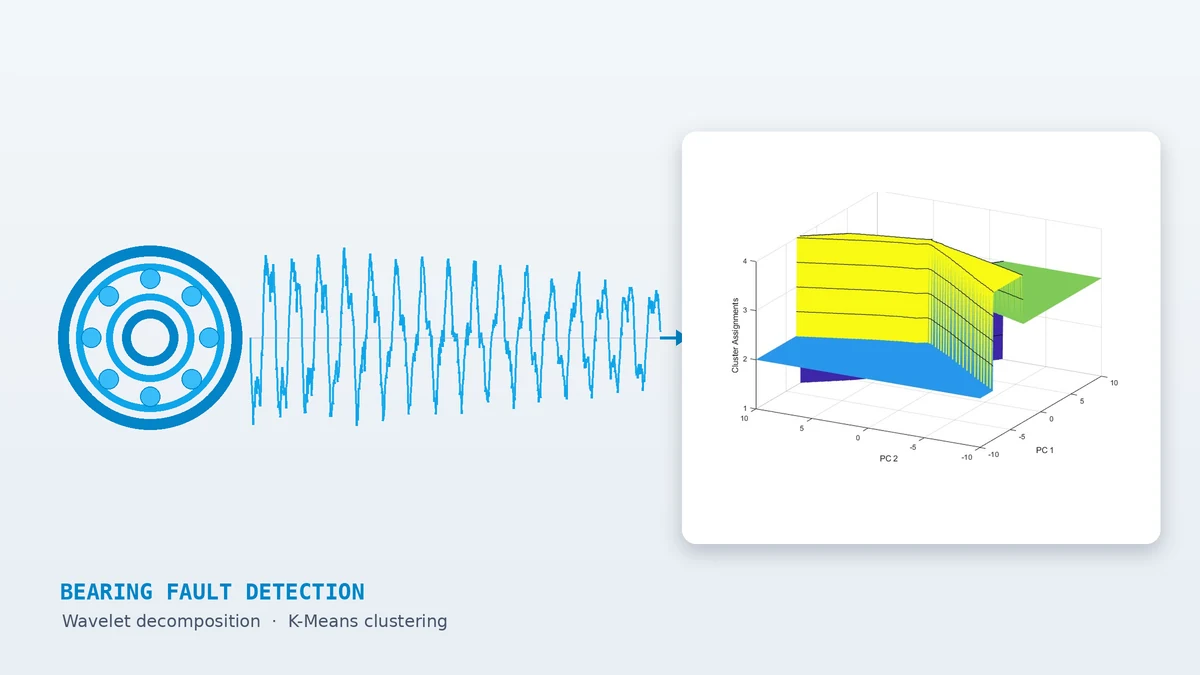
The approach used the discrete wavelet transform (DWT) and the lifting scheme method to decompose vibration signals into approximate and detail coefficients across multiple frequency bands. Statistical markers, variance, mean, standard deviation, median, percentiles, and RMS, were calculated from these coefficients to build a feature matrix. Principal component analysis reduced the dimensionality, and the resulting features were fed into a K-Means clustering algorithm to classify fault and non-fault conditions.
The methodology was tested on two publicly available datasets that differ significantly in their characteristics: the Case Western Reserve University (CWRU) dataset, which uses artificially induced faults at known locations, and the NASA Intelligent Maintenance Systems (IMS) dataset, where faults propagated naturally through run-to-failure testing. This dual-dataset approach was deliberate, a method that only works on clean lab data with seeded faults has limited industrial value.
The method achieved 88% accuracy on the CWRU dataset and 75% on the NASA dataset. The lifting scheme was shown to produce equivalent wavelet coefficients 17.79% faster than the traditional DWT, a meaningful difference for resource-constrained edge devices and real-time monitoring applications.
The research demonstrated that wavelet-derived statistical features combined with unsupervised clustering can identify bearing fault conditions without requiring prior knowledge of bearing geometry, fault frequencies, or operating speed. This is a practical step toward condition monitoring systems that can be deployed across diverse machinery without individual tuning, a significant barrier to adoption in industry today.
The work directly informed Thomas's practical condition monitoring projects in food manufacturing and connects to his broader PhD research into AI-driven approaches for industrial process control.
Keywords
- Discrete Wavelet Transform
- Lifting scheme
- K-Means clustering
- Condition-based monitoring
- Vibration analysis
- Principal component analysis
- NASA IMS dataset
- CWRU dataset