

HEMS-Guided PSO for Energy-Efficient Pump Scheduling
A research-led optimisation study investigating how hydraulic simulation, energy screening, and particle swarm optimisation can be combined to improve pump scheduling in water-treatment intake systems, with the aim of reducing energy use while preserving hydraulic feasibility, resilience, and practical compatibility with existing plant control.
- Theme
- Digital Twin Optimisation
- Status
- active
Research Overview
Pumping is one of the largest energy consumers in water and wastewater infrastructure. Intake pumping stations are typically controlled using lead/lag logic, duty rotation, availability rules, and PID trim. This approach is robust and familiar to operators, but it often assumes that each pump has broadly equivalent energy cost. In real plants, that assumption is rarely perfect. Pump efficiency can change because of wear, fouling, installation effects, motor or drive condition, hydraulic losses, or operating point drift.
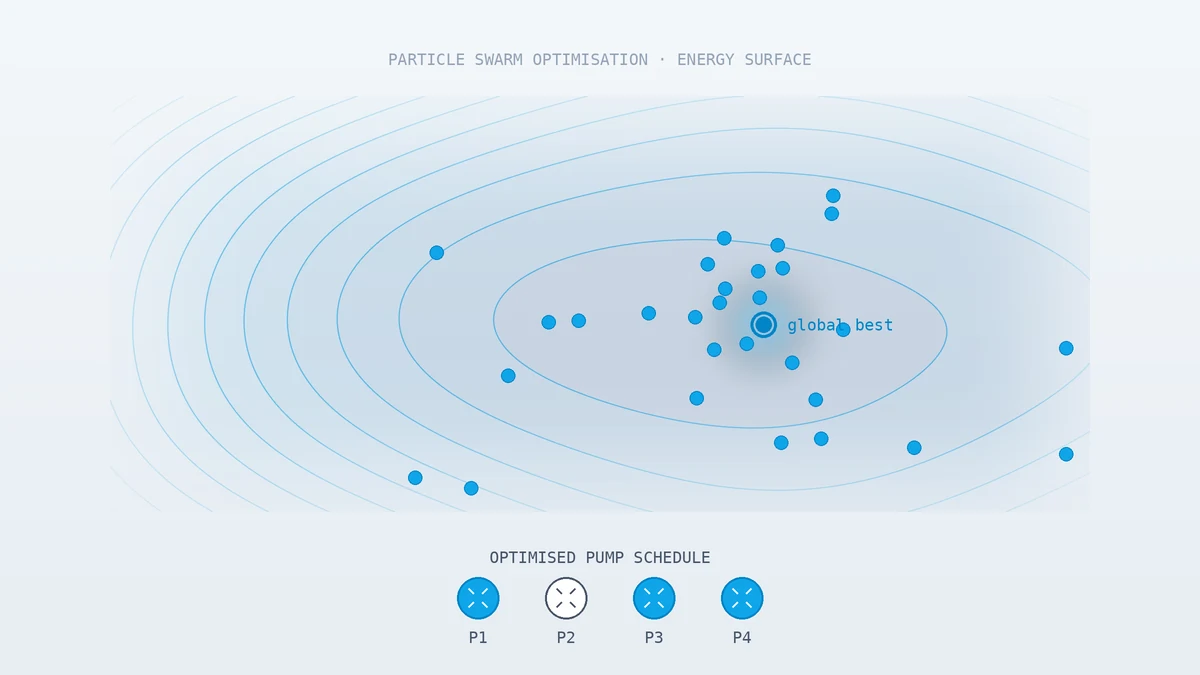
Thomas Hadden's HEMS-guided PSO research explores how digital twin modelling can be used to make pump scheduling more energy-aware without replacing the practical control structures already used on site. HEMS stands for Hydraulic Energy Mask Screening. The method uses a one-dimensional hydraulic model to screen candidate pump combinations before optimisation, rejecting pump masks that are infeasible or unlikely to be energy efficient. Only the most promising masks are then passed to a particle swarm optimisation stage, where the active pump speeds are optimised.
The work is currently applied to the intake area of a clean water treatment plant, modelled in Siemens Simcenter Flomaster. The system consists of five vertical turbine pumps transferring raw water from a reservoir to a treatment works. Each pump is rated at approximately 250kW, with an individual capacity of around 500 L/s. The plant requires enough redundancy to maintain delivery under changing demand, maintenance conditions, and pump availability constraints.
The HEMS workflow has two stages. First, each candidate pump mask is simulated at minimum and maximum speeds. Masks that cannot meet the required delivery range, or that over-deliver beyond acceptable limits, are rejected before the optimiser is used. Second, the remaining masks are evaluated using a power-law interpolation step to estimate the speed required to meet the target flow. The best-ranked masks are then passed to particle swarm optimisation, where pump RPM setpoints are refined for each selected mask.
The final output is a feed-forward lookup schedule that recommends a pump mask and nominal speed setpoints for each flow region. Existing PID control remains in place as a bounded trim layer, which is important from a practical adoption perspective. The research does not assume that AI or optimisation should directly replace plant control; instead, it investigates how optimisation can sit above conventional PLC-based control as a supervisory scheduling tool.
In the current degraded-pump replay experiment, Pump 3 was deliberately modelled with reduced motor efficiency to test whether the HEMS-guided schedule could avoid an inefficient asset where hydraulically feasible alternatives existed. The same two-hour demand profile was replayed against both a conventional PID baseline and the HEMS-guided lookup schedule, with demand varying between approximately 900 L/s and 1200 L/s.
The preliminary replay results were encouraging. The HEMS-guided schedule reduced total electrical energy from 1068.67 kWh to 864.19 kWh, equivalent to approximately 19.1% in the degraded-pump scenario. Specific energy reduced from 138.13 kWh/ML to 111.40 kWh/ML, while delivered volume was maintained. Mean absolute flow error also improved, and time outside the 3% flow deadband reduced compared with the baseline replay.
These results should be interpreted carefully. The energy saving is strongly linked to the deliberately imposed pump degradation and should not be presented as a general saving expected under all plant conditions. The more important research contribution is the workflow itself: using a hydraulic digital twin to screen feasible pump combinations, reduce wasted optimisation effort, and generate practical schedules that can be tested offline before any live plant trial.
The next stage of the work is to improve the optimisation fidelity, investigate smaller flow bins, explore interpolation between lookup-table rows, and connect the optimisation model to plant-derived pump condition indicators. This would allow future schedules to adapt as pump performance changes over time, creating a bridge between condition monitoring, digital twins, and energy-aware process control.
Keywords
- HEMS
- Particle swarm optimisation
- Pump scheduling
- Digital twins
- Simcenter Flomaster
- Water treatment
- Energy efficiency
- Hydraulic simulation
- Pump condition
- PLC integration