
AI-Driven Innovation in Industrial and Process Control Systems
A part-time PhD at Ulster University investigating how reinforcement learning and digital twin methodologies can be applied to real-world industrial process control, with a focus on the gap between academic theory and practical adoption in safety-critical environments.
- Theme
- Industrial AI
- Status
- active
Research Overview
Most academic research into AI for process control demonstrates strong theoretical performance, in simulation, on benchmark problems, under idealised conditions. But the gap between what works in a paper and what works in a live water treatment plant or manufacturing facility is substantial. Thomas Hadden's PhD research, titled AI-Driven Innovation in Industrial and Process Control Systems (AIPCon), sits directly in that gap.
The programme is a part-time PhD at Ulster University, running alongside Thomas's commercial role at Park Automation. This dual position is deliberate, it ensures the research stays grounded in the constraints that real industrial systems impose, rather than drifting toward solutions that only work in simulation.
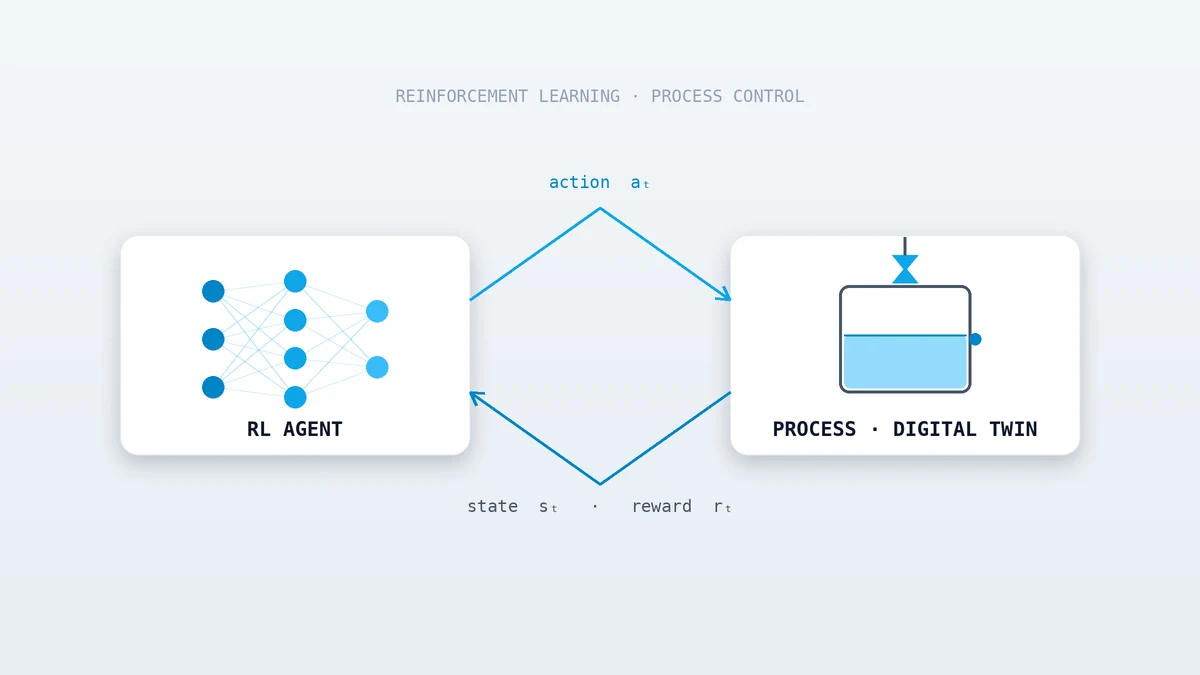
The research investigates two related areas: reinforcement learning for control, and digital twin methodologies for industrial process systems. The current phase is focused on a structured literature review that surveys the state of the art in both areas, paying particular attention to how proposed techniques handle the real-world constraints that academic work often overlooks, process non-linearities, measurement uncertainty, sensor limitations, safety requirements, and integration with existing PLC-based control architectures.
A key objective of the literature review is to identify and document the specific gaps between what has been published and what has actually been deployed. This includes examining why certain techniques with strong theoretical results have seen limited industrial uptake, and what engineering, regulatory, or practical barriers are responsible.
In parallel with the academic work, Thomas is developing digital twin models using Siemens Simcenter Flomaster software, applied to real water utility infrastructure. The current application involves a 1D CFD model of the intake area of a clean water treatment plant, consisting of five Andritz VTP410 200kW pumps. The objective is to demonstrate offline a particle swarm optimisation algorithm that can schedule intake pumps more energy-efficiently than the conventional heuristic control philosophy currently in use.
If the simulation results are positive, Thomas intends to propose a live plant test with a water utility partner, an opportunity that would be significant both commercially (in terms of energy savings for the utility) and academically (live plant tests in this field are rare, and the work would be developed into a research paper alongside the pilot).
The PhD is supervised at Ulster University, with regular supervisory meetings, participation in research discussions, and engagement with the wider academic community. The research programme is expected to run until 2031.
Keywords
- Reinforcement learning
- Digital twins
- Process control
- Simcenter Flomaster
- CFD modelling
- Particle swarm optimisation
- PLC integration
- Safety-critical systems